Images of Singapore LIVE & Madame Tussauds


The Madame Tussauds Singapore is located at the Imbiah Outlook on Sentosa Island.


Singapore Girl welcomes you at the ticket counters.

Before entering Madame Tussauds, we have to take a tour in the Images of Singapore LIVE. Photo-taking is not allowed inside the attraction, where an actor (or actress) is stationed at each exhibition zone to narrate the history. The sequence of the exhibition is chronological (as expected), bringing the visitors through the development from our early days.


Old soft drink glass bottles that are no longer sold in Singapore.


At the end of the corridor, there's a trishaw on display. It was a common public transportation in the past. Today, tourist take a ride on them for a cultural experience.

The Images of Singapore LIVE took us about one hour to complete. After a really short indoor boat ride, we can finally see the life-size wax figurines of famous people in Madame Tussauds.


Our first Prime Minister, Mr Lee Kuan Yew, and his wife.


Our second Prime Minister, Mr Goh Chok Tong.
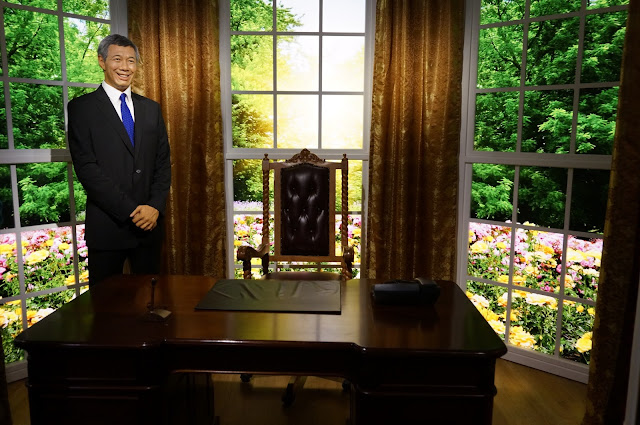

Our current Prime Minister, Mr Lee Hsien Loong.


Exhibit showing the steps in wax modelling.


Local actress Zoe Tay (鄭惠玉) at the TV station.


Local singer Stefanie Sun (孙燕姿)


Taiwanese singer Jay Chou (周杰伦)


Marilyn Monroe


British actress Audrey Hepburn in Breakfast at Tiffany's.


Merchandise at the store

There are many other wax figures of leaders, athletes, actors and singers. I didn't have the opportunity to take photos of many because there is constantly people taking selfies with the figures. I'm not really a huge fan of wax museums, but KB had always wanted to visit them. We didn't manage to go to the one in Hong Kong two years ago, because it was way too crowded. So, we went to Madame Tussauds Sydney mid of last year. Way back in 1998, I've visited the original Madame Tussauds London during a school overseas trip. Most (if not all) of the non-local celebrities can also be found in the other Madame Tussauds around the world, but the poses of these repeated figures are different in different countries. By the way, the wax figure of Mr Lee Kuan Yew had already been on display in London when I was there!

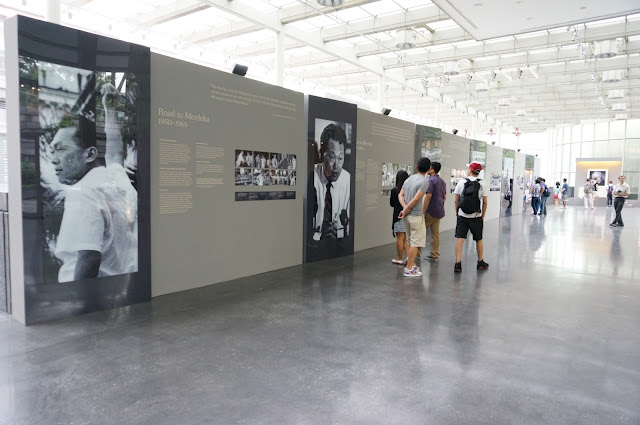
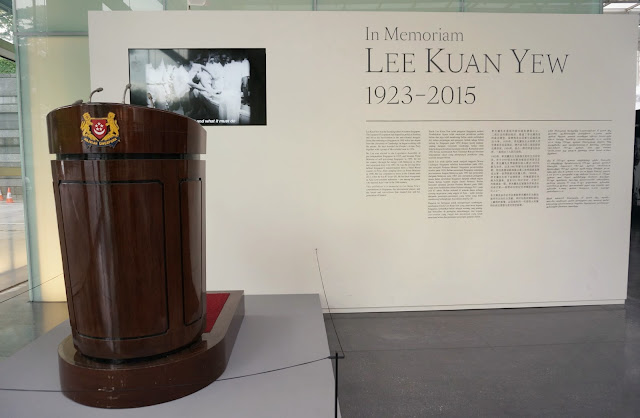
In Memoriam: Lee Kuan Yew


In Memoriam: Lee Kuan Yew exhibition held at the National Museum of Singapore from 25 March 2015 to 28 June 2015.


Navigate to this website for the exhibition guide or you can always pick up the hardcopy book.


Barrister wig and container


Rolex Oyster Perpetual watch and the letter from John Laycock.


The glass master plate used for printing leaflets for Lee Kuan Yew's campaign as a PAP candidate in the 1955 General Elections.


Left: Leaflet for Legislative Assembly General Election (1959)
Right: Leaflet for Legislative Assembly By-election at Tanjong Pagar (1957)


The timeline of Mr Lee's contributions to the development of Singapore.


The rosewood rostrum used by Prime Minister Lee Kuan Yew to deliver his National Day Rally in the 1970s.


Red ministerial box


The state flag that was draped over the late Mr Lee Kuan Yew's casket was added to the exhibition on 28 April.

SINGAPURA: 700 Years


This exhibition is divided into six sections and has a worksheet that can be downloaded from the National Museum of Singapore website. Unfortunately, section 1 (Archaeology in Singapore) wasn't open on the day I visited.

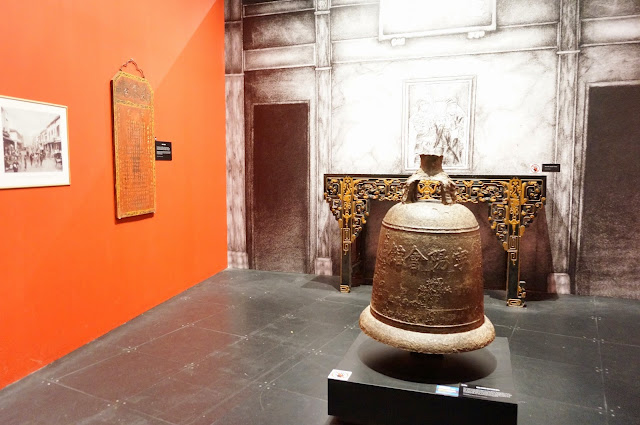
Section 2 talks about the ancient Singapore (1300 to 1818). During the Ming Dynasty, there were texts and maps describing the Dragon Tooth Gate, which was a rock formation protruding out of the sea. It was the entrance into the Keppel Harbour we have today. Some years later, A British map named the rock "Lot's Wife".


The five kings of Singapura were Sri Tri Buana, Sri Pikrama Wira, Sri Rana Wikerma, Paduka Sri Maharaja and Sri Sultan Iskandar Shah. Sri Tri Buana was a princely descendant of Alexander the Great and he was more commonly known as Sang Nila Utama to Singaporean, as that was what we had learnt in our history lesson in school.


This artifact is a fragment of the Singapore Stone, which stood at the mouth of Singapore River. The inscription on the stone was evidence that there were human inhabitants as early as the 10th to 13th century.

Section 3 brings us to the colonial period (1819 to 1942), when the British gained the control of Singapore.


Singapore became a thriving port and migrants flocked from Malaya, China and India.


Historical landmark buildings

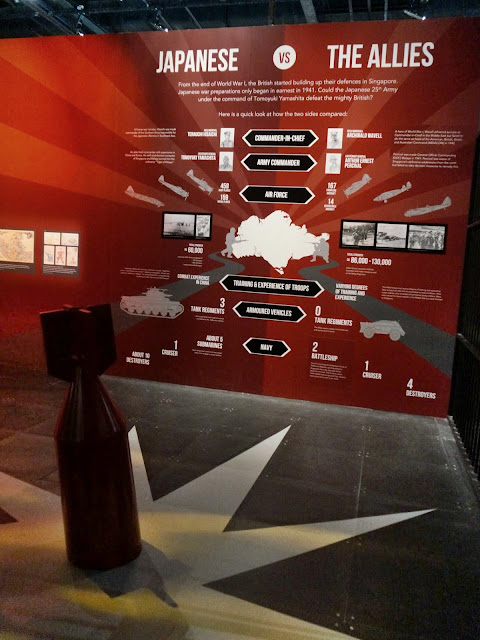
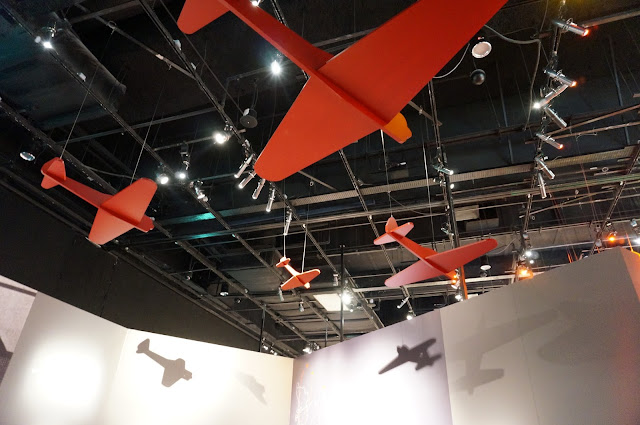
Section 4 recounts the life during the Japanese Occupation (1942 to 1945). Then, Singapore was renamed Syonan-To, meaning "the Light of the South". There's constantly a humming sound of the military planes flying overhead, like there's going to be an airstrike.


The Japanese language and cultures were taught in schools.


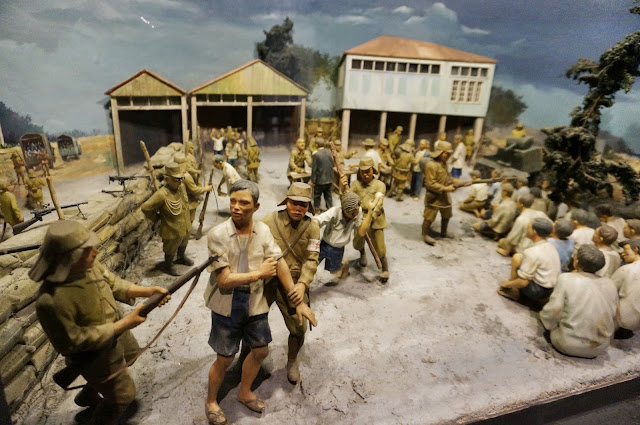
Operation Sook Ching was carried out in an attempt to eliminate anti-Japanese sentiments in the Chinese community.


W R M Haxworth was a former policer inspector, who became a prisoner of war. These are some of his many sketches made during his time in jail.

Section 5 features the postwar years (1946 - 1965), the period of struggle to independence.


Colony of Singapore Annual Report


There are a few audio stations in this section of the exhibition.


Elections and the political parties in those days.

Section 6: Independent Singapore (1965 to 1975).


This area of the exhibition is designed to resemble the kind of housing environment we had. Other than this void deck shown in the photo, there's a display of a typical living room in a HDB flat, as well as a merry-go-round (which you can actually hop on and make your friend push you round and round).

NTU Chinese Heritage Centre

The Chinese Heritage Centre in Nanyang Technological University does not charge admission fees for Singapore citizen and permanent residents.


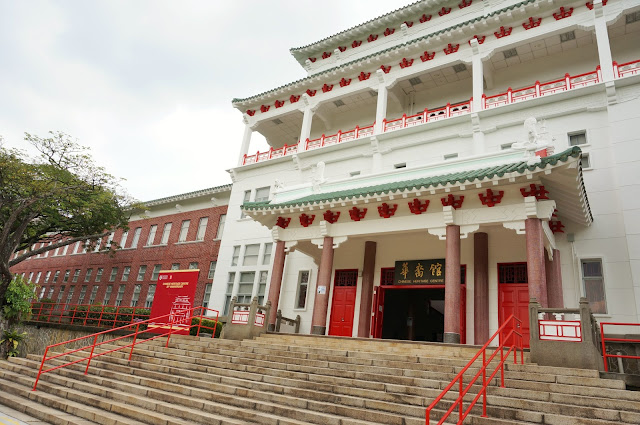
Standing at the bottom of the stairs, I can only manage to capture half of the building in my photo.


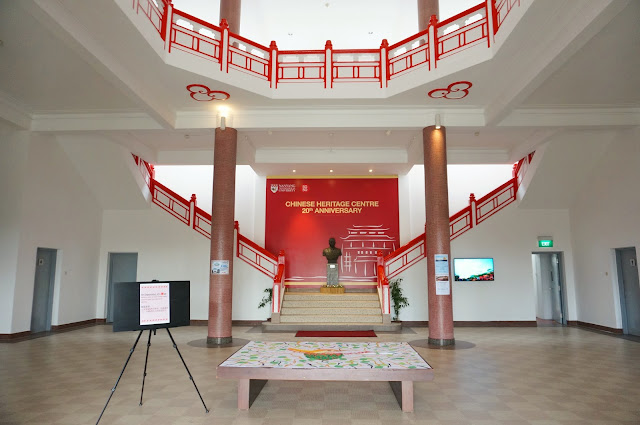
The ground floor houses the library.


This one-and-only hand-embroidery named Hundred Flowers Blossom (百花齐放) is placed on the second floor. This embroidery on silk took about 4.5 years to complete and it involved about 400 workers in China.


The Nantah Pictorial Exhibition is also found on the second floor.


It's not a big exhibition, but it records the founding of the university.

Thow Kwang Pottery Jungle


Thow Kwang Pottery Jungle has the oldest dragon kiln in Singapore. The family business is located near CleanTech Park and its entrance is at the Ficus Lookout of Jurong Eco-Garden. In 2010, Martha Steward visited this kiln and wrote about it on her website.


The dragon kiln (龙窑) is used in pottery making to glaze the clay. It has to be built on a gentle slope, with the "dragon head" positioned at the lower ground. During firing, firewood is fed into the "dragon head" and the heat from the fire travels up the kiln. Along the kiln body, more firewood can be fed into the stoke holes to achieve an even distribution of heat in the kiln. The smoke escapes through the opening at the "tail".


There are several of such entrance for the potters to place their artwork inside the kiln. Then the entrance will be sealed with brick and clay for the firing process.


Inside the empty kiln.


During our pre-arranged guided tour organised by NTU, we didn't get to watch the firing of the kiln. However, there was a short demonstration of pottery making using the potter's wheel.


The pottery has a large collection of different themed porcelain products.


Vintage rooster bowls


They provided assistance and support for The Little Nyonya (小娘惹) Chinese drama serial by MediaCorp in 2008.