We left Taipei City after a hearty breakfast at Home Hotel, but when we reach Sun Moon Lake, it was already time for lunch. We quickly left our luggages at our hotel and went out nearby in search for food. Not too far away, on the next street, we stumbled upon Moon Tea & Coffee. It's a homely cafe with alfresco dining and a nice view of the lake.


Now, we're ready to see the attractions! After studying the visitor guide, we decided to spend our evening traveling to one that is rather out of the way: Kong Ming Temple (孔明廟). We walked back to the visitor centre to ask for directions and was told to wait for the shuttle bus. Totally clueless to the landmark, we depended on the driver to alert us to alight. This is one attraction that most tourists would miss, perhaps because it's really out of the way and quite far from the lake. Also, this is not the only temple around the lake.


Then, we took the shuttle bus back to the lake and for the rest of the late evening, we took a slow stroll along the boardwalk near our hotel, until the sky began to turn dark. The last shuttle bus service is at 6pm and the boats stop operating at 4.30pm. There isn't much night activity here... so, we ended up playing games on our portable devices in our room, after our dinner at the hotel itself.
Just before the counter at the visitor centre closes, we managed to buy the Sun Moon Lake Pass. For reason(s) unknown to us, the lady at the counter wasn't very friendly nor helpful when we approached her with questions. This was very unlike the usual good services that we've experience at any other parts of Taiwan.
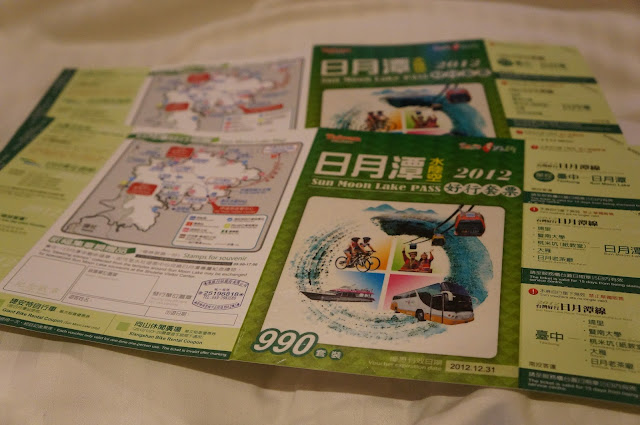
The following day, we set off to tour around the lake. Starting from the Shueishe pier (水社碼頭), we took the boat ride to Syuanguang pier (玄光碼頭).


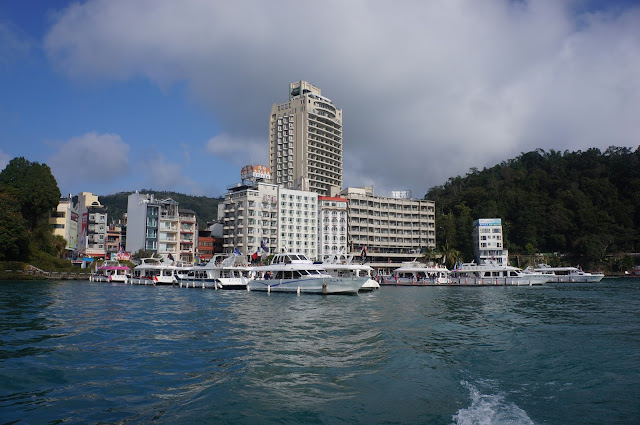
Between the two piers, we passed by the Lalu Island (拉魯島), which used to be much bigger than it is now. The boat slowed down near the island for visitors to take a look at it.
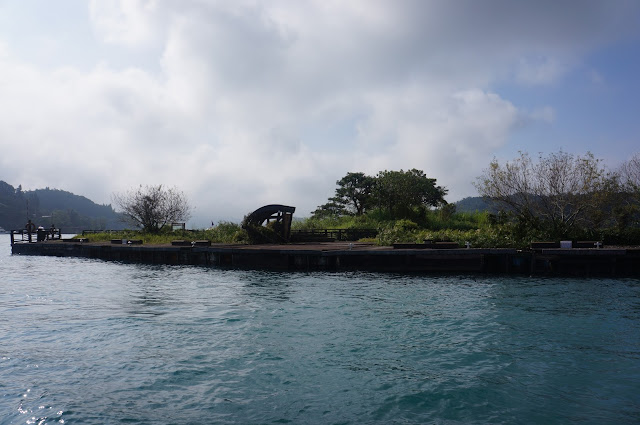
The Syuanguang Temple (玄光寺) is located at the Syuanguang pier (玄光碼頭). On our visit, it was very crowded with visitors. According to the tour guide on the boat, the tea egg (茶叶蛋) is a "must-try". But I was still so full from my breakfast, and there were so many people at the stall, we gave that a miss. We continue walking and after a small flight of stair, is where the temple is located. There isn't much to see there.
I was more keen to see Syuentzang Temple (玄奘寺). However, there wasn't any signage to lead us there! After asking around, no one seems to be able to offer any useful help! I was pretty sure that there has to be a bus to take us there, but I was told that Syuanguang Temple (玄光寺) is the terminal bus-stop. After wandering around, we decided to take the walking trail up the mountain.


A fabulous view greeted us when we finally reach the temple. I was really glad that we made this visit, even though I was really exhausted climbing the mountain! From the observatory deck, we could see Lalu Island (located in the middle of Sun Moon Lake). There wasn't much visitors at Syuentzang Temple (玄奘寺) and we could enjoy the peaceful surroundings.

View from observation deck across the road from the Syuentzang Temple (玄奘寺)

Entrance of Syuentzang Temple (玄奘寺)


It's interesting to find an automated 求签 (pray and draw a divination lot) machine, almost like a vending machine, which even played music while retrieving the lot. And it's a good money-making device too! Even for us who do not believe in such things, we put in our coins, just to see the machine operate.

I was right about the fact that there is a bus station at Syuentzang Temple (玄奘寺) and the bus-stop is right outside the temple! So we took the bus back to Syuanguang Temple (玄光寺), walked back to Syuanguang pier (玄光碼頭) and took the boat. Next stop: Ito Thao Pier (伊達邵碼頭).

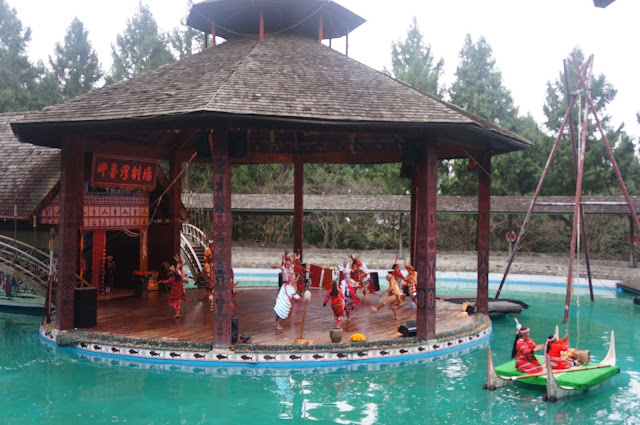
Afterwhich, we headed towards the Ropeway Station (纜車站), where we can take the cable car to Formosa Aboriginal Culture Village (九族文化村). Beside the exhibits to learn about the cultures of nine tribes, there's also an amusement park.



From the Ropeway Station (纜車站), we took the Lake Tour Bus to get to Wenwu Temple (文武廟). The bus travels in both directions from Shueishe Visitor Center (水社游客中心) and back.


This concludes our tour around the lake (anti-clockwise direction).